Shortcode Cleaner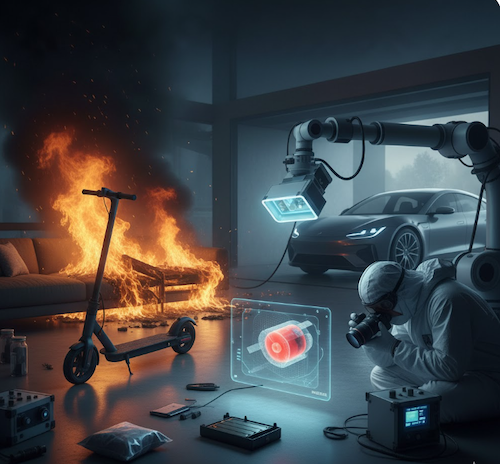
From the sleek smartphone in your pocket to the powerful electric vehicle in your garage, lithium-ion batteries have become the invisible engine of modern life. They provide high energy density and rechargeability that fuel our convenience driven world. Yet, with their proliferation comes a growing and insidious danger: the risk of a catastrophic fire. These aren't your typical blazes. Lithium-ion battery fires are fast, ferocious, and notoriously difficult to extinguish, demanding a new level of awareness from consumers and a specialized response from forensic engineering.
When the battery is subjected to abuse, be it physical damage, overcharging, or exposure to extreme temperatures, the separator can break down. This allows the anode and cathode to touch, creating an internal short circuit. This shortage generates a rapid increase in heat, which, in turn, causes the electrolyte to vaporize and violently ignite. This phenomenon is known as “thermal runaway”. The heat from this single event can then trigger a chain reaction, causing adjacent cells to go into thermal runaway, resulting in a fire that is self-sustaining and incredibly difficult to contain.
While major events like a cargo ship fire or an EV recall make headlines, the reality is that lithium-ion battery fires are a hazard in every home. Unattended charging of e-bikes, damaged power tool batteries, and even counterfeit phone chargers can all be the cause of a devastating fire. This is where forensic engineering becomes essential.
The Critical Role Of Forensic Engineering
When a lithium-ion battery fire occurs, the scene is often chaotic and the evidence heavily damaged. Traditional fire investigators are trained to identify burn patterns and other signs of fire origin, but these clues can be misleading in a battery fire. A forensic electrical engineer must possess a unique blend of skills to determine the root cause of the incident.
Scene Examination: Documenting the scene with high-resolution photography and 3D laser scanning to create a digital model of the area before any evidence is disturbed.
Component Analysis: Carefully disassembling the battery pack to inspect individual cells, wiring, and the Battery Management System (BMS). The BMS is the “brain” of a battery, a circuit designed to prevent overcharging, over-discharging, and overheating. A failure in this system is often a key piece of evidence.
Microscopic and X-Ray Analysis: Utilizing advanced techniques like scanning electron microscopy (SEM) and X-ray imaging to look for microscopic defects or manufacturing flaws within the cells that could have initiated the thermal runaway.
Data Retrieval: In some cases, forensic engineers may be able to retrieve data from the BMS or other onboard electronics to see if the device was being used outside its operating parameters.
The purpose of this rigorous investigation is to answer the fundamental questions: Was the fire a result of a manufacturing defect, improper use, or an unforeseen electrical fault? The findings are crucial for litigation, insurance claims, and, most importantly, for contributing to the body of knowledge that improves battery safety standards for everyone.
What You Can Do to Protect Your Home
While the risk is real, knowledge and simple precautions can drastically reduce the chances of a fire. As a homeowner or consumer, you have the power to protect yourself and your family.
● Use the Right Charger: Always use the charger that comes with the device or a certified third-party charger from a reputable brand. Using a cheap, incompatible charger can deliver an incorrect voltage or current, which can damage the battery and lead to a fire.
● Avoid Overcharging: Never leave devices plugged in and charging unattended or overnight, especially under your pillow or on a bed. Once a device is fully charged, disconnect it. A well-functioning BMS will prevent overcharging, but a faulty one can fail to do so.
● Store and Charge Safely: Keep devices and batteries in a cool, dry place, away from direct sunlight and heat sources. Charge larger devices like e-bikes and scooters in a garage or away from living areas, and never near an exit or a primary escape route.
● Watch for Warning Signs: Be on the lookout for any signs of battery degradation. If a battery is swollen or bulging, leaking, unusually hot to the touch, or emitting a strange odor, stop using it immediately. Do not attempt to charge a damaged battery.
As technology continues to evolve, so do the challenges. The rise of lithium-ion battery fires is a clear reminder that innovation must be accompanied by a strong commitment to safety. By understanding the risks, taking preventative measures, and relying on the meticulous work of forensic engineers, we can ensure that our modern conveniences don't become a hidden danger.