Shortcode Cleaner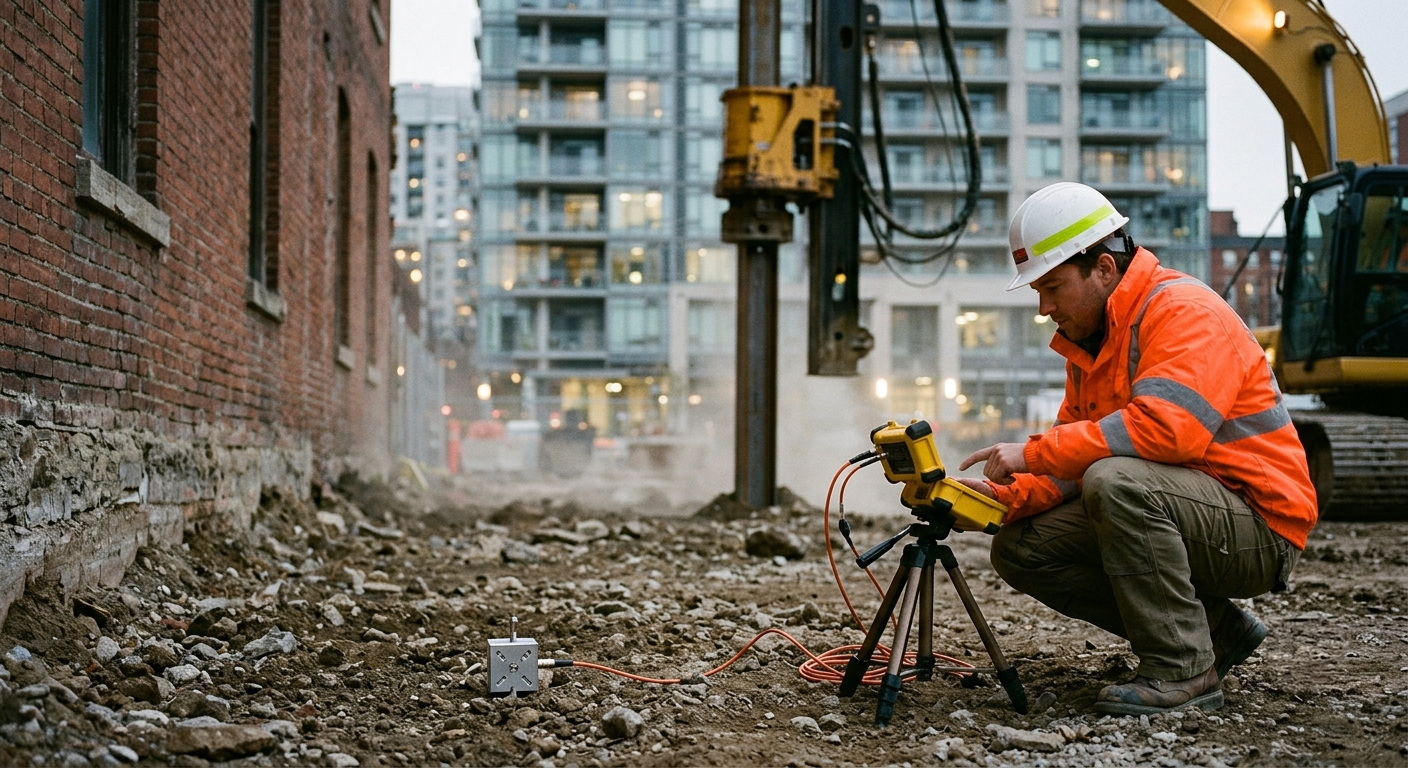
To a homeowner, a nearby blast feels like an earthquake. To a claims adjuster, it looks like a multimillion-dollar headache. To a lawyer, it represents a complex battle of causation versus coincidence. In the high stakes' world of construction and blasting, the difference between a dismissed claim and a massive payout often comes down to what you can prove before the first crack is even reported.
What is Vibration Monitoring?
At its core, vibration monitoring is the measurement of ground borne energy generated by activities such as blasting, pile driving, or heavy soil compaction. Forensic engineers often utilize specialized instruments known as triaxial geophones. These sensors measure movement in three dimensions, vertical, longitudinal, and transverse, to calculate the Peak Particle Velocity. Unlike human perception, which is subjective and highly sensitive to low-level movement, vibration monitors provide an empirical black box for the job site. By documenting the frequency and amplitude of every seismic event, these devices allow experts to compare site data against established safety thresholds, such as the U.S. Bureau of Mines criteria, to determine if structural damage was even physically possible.
The Forensic Engineering Safeguard
Engaging a forensic engineer during new construction is a strategic investment in risk mitigation. The engineer’s role begins long before the blasting commences, starting with the Pre-Condition Survey. By meticulously documenting the existing state of surrounding structures, noting every hairline crack and foundation settlement, the engineer establishes a baseline of truth.
Forensic engineers don't just record data; they interpret it in real-time. If vibration levels approach safety limits, the engineer provides immediate technical guidance to modify blasting patterns or construction methods, preventing damage before it occurs and maintaining regulatory compliance.
Data Vs Perception
Ultimately, a proactive approach to vibration monitoring transforms a potential legal battlefield into a manageable technical process. By replacing the subjective feeling of a shaking floor with objective, timestamped data, forensic engineers provide the clarity needed to resolve disputes swiftly. For claims adjusters and legal professionals, this scientific rigor doesn't just defend against meritless claims, it provides the documented peace of mind that project integrity was maintained from the first blast to the final inspection.