Shortcode Cleaner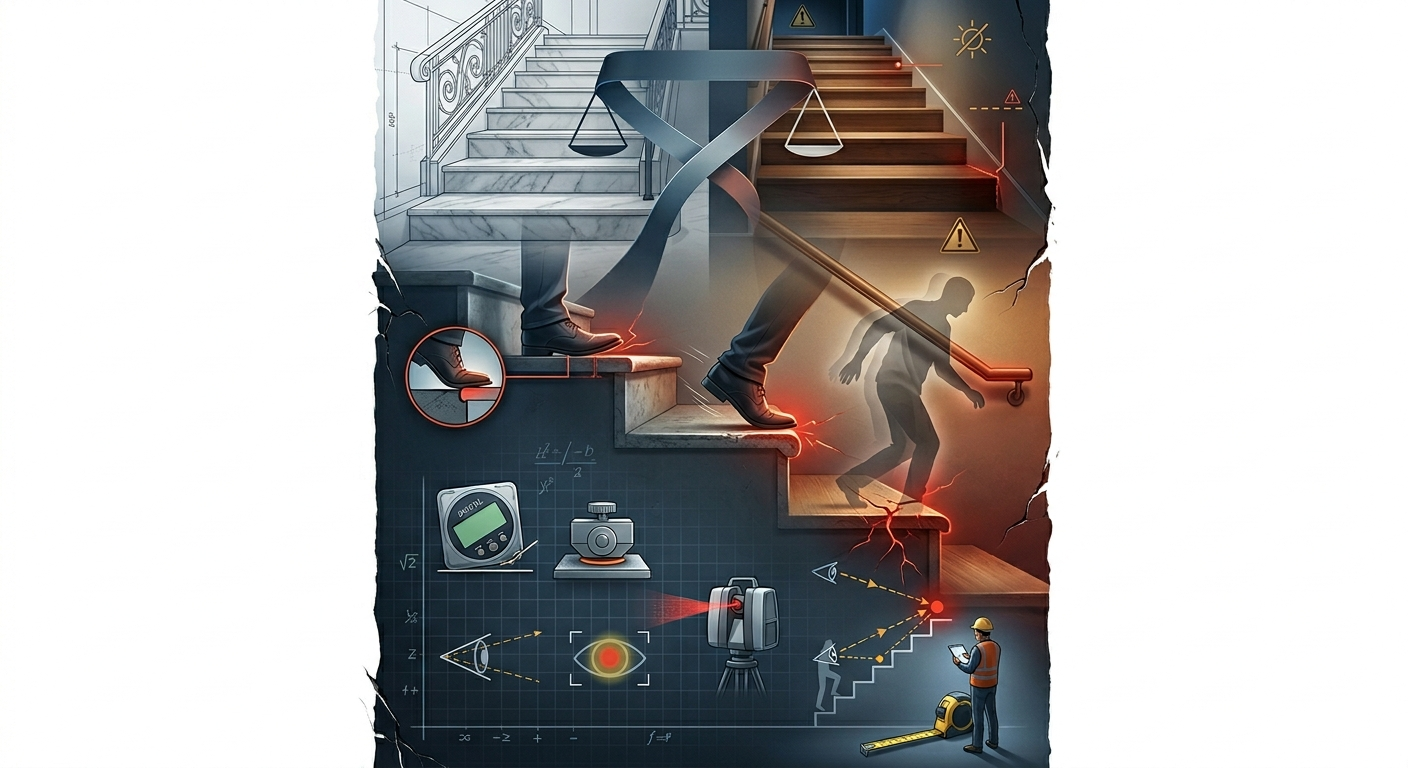
Whether it’s a dimly lit basement stairwell in a private residence or a grand marble staircase in a luxury hotel, a single misstep can transform a routine transition into a legal and medical event. For the claims adjuster, it’s a high-exposure file, for the attorney, it’s a meticulous battle of inches and coefficients, and for the injured, it can be a life-altering injury. In the world of premises liability, stairs are more than just architectural features, they are high-risk zones where the standard of care is measured by the fraction of an inch, and where the difference between a dismissed claim and a multi-million-dollar verdict often rests on the precision of a forensic ruler.
The Standard Duty of Care: A Sliding Scale
In premises liability, the legal obligation of a property owner, the duty of care, is not a one size fits all rule. It is dictated primarily by the relationship between the owner and the pedestrian.
- Business Owners: Businesses owe the highest duty to invitees (customers). They must keep the premises in a reasonably safe condition, which includes a duty to inspect the stairs for hidden dangers and proactively repair defects like loose carpeting or failing handrails.
- Homeowners: Generally, homeowners owe a duty to licensees (social guests) to warn them of known, non-obvious dangerous conditions. While they may not be required to conduct the same rigorous daily inspections as a retail store, I didn't know, is a weak defense if the hazard was blatantly obvious or existed for a long duration.
Regardless of the setting, the core question remains: Did the owner act as a reasonably prudent person to prevent a foreseeable fall?
Anatomy of a Fall: Why Stairs Fail
Stairway accidents rarely result from a lack of ability from the user. Human gait on stairs is a highly rhythmic, subconscious process. When that rhythm is interrupted by a physical defect, the brain cannot adjust fast enough to prevent a fall. Common culprits include:
- Non-Uniformity: The human foot expects every step to be the same height and depth. A variation of even 3/8 of an inch between steps can increase the risk of a trip and fall while ascending, and a misstep while descending.
- Improper Nosing: The edge of the step must be visible to allow pedestrians to recognize where the step ends. The edge should also be slip resistant, as rounded or worn down edges cause the foot to slide off.
- Handrail Deficiencies: Handrails that are the wrong height, not continuous, not graspable, or missing entirely turn a minor stumble into a full speed descent. Stair users can use the handrails to prevent a total fall from a loss of balance event.
- Environmental Factors: Poor lighting and visual noise such as distracting patterns on carpets can camouflage the edge of a step, leading to a misstep while descending.
The Role of Forensic Engineering: Turning Data into Evidence
When a fall occurs, this is where forensic engineering becomes the linchpin of the case. A forensic engineer uses specialized tools to quantify the danger:
- Tape measures and rulers: To record the height of risers, depth of threads, height of handrails and verify their uniformity.
- Digital Inclinometers: To measure the slope of threads and landings.
- Tribometers: To determine the Coefficient of Friction or Slip Resistance of the stair thread surface.
- Human Factors Analysis: To explain how expectancy and conspicuity (how visible the hazard was) influenced the fall.
Forensic engineers can verify if the stairs met the applicable codes and standards or if it presented any hazard to pedestrians. By recreating the physics of the incident, forensic engineers can determine if a fall was caused by user error or if the staircase had a defect that exists but is not easily discoverable by the average person.
Stairway cases are won and lost in the details. For adjusters and lawyers, success depends on moving past the surface level report and diving into the geometry of the structure. For the property owner, the standard of care is a continuous obligation. In a realm where a half-inch deviation constitutes negligence, the only true defense is rigorous maintenance and adherence to code.