Shortcode Cleaner
Severe rainfall events and rapid development have driven a sharp rise in high-value property damage claims. When stormwater floods a residential basement, damages a commercial foundation, or causes a retaining wall failure, property owners and insurers often face immediate, costly losses. For claims adjusters, subrogation specialists, and attorneys, the critical question is rarely what was damaged, but rather why the stormwater resulted in damage, and who bears legal liability.
Determining whether flooding resulted from an unpreventable “Act of God,” inadequate municipal infrastructure, improper grading by a developer, or long-term owner neglect requires forensic engineering analysis.
Natural Water Flow vs. Unnatural Diversion
In drainage investigations, identifying the root cause of flooding hinges on a single physical reality: Did a site change or structural alteration unnaturally divert, concentrate, or increase the volume and velocity of surface water onto another area? Some common scenarios regarding draining issues are listed below:
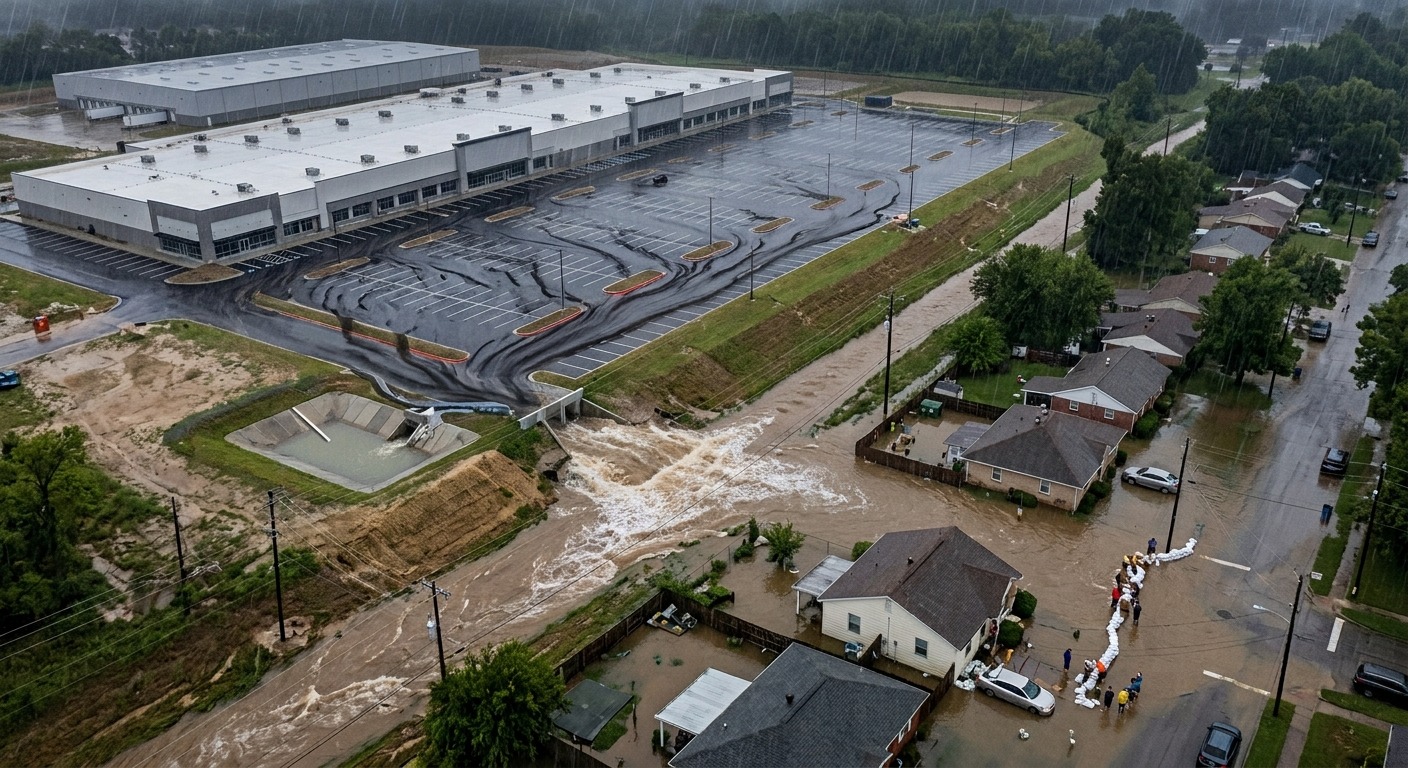
Upstream Commercial Development: A newly constructed shopping center or warehouse increases a site’s overall impervious surface area (roofs, concrete loading docks, asphalt parking lots). If retention basins or outlet structures are undersized or stormwater flows miscalculated, peak stormwater runoff surges onto neighboring lower-lying properties.
Residential Infill & Regrading: A property owner installs a pool, builds a large patio, or alters the grade along a shared property line. These modifications can inadvertently redirect natural swales and redirect surface runoff against adjacent foundation walls.
Maintenance Failures: Clogged culverts, collapsed underground drainage pipes, or silted-in retention ponds cause water to back up into adjacent structures during standard, predictable rainfall events.
How Engineers Establish Causation
Forensic engineers approach drainage failures using a multi-step, data-driven methodology to separate subjective assumptions from objective physical science.
Topographic & Elevation Mapping: Utilizing high-resolution LiDAR, aerial photogrammetry, and historical topographic maps, engineers reconstruct pre- and post-development land contours to precisely map drainage basins and stormwater flow paths.
Precipitation Data Analysis: Engineers retrieve detailed historical rainfall data from NOAA or local weather records for the exact time of the event. This determines whether the storm fell within standard regional design parameters or exceeded the design capacity of existing infrastructure.
Hydrologic & Hydraulic Modeling: Using industry-standard software (such as HEC-HMS, HEC-RAS, or EPA SWMM), engineers calculate runoff volume, flow velocity, and peak discharge rates. This modeling quantifies how much water moved across the site and demonstrates how specific alterations changed the natural flow pattern.
On-Site Physical Inspection: Engineers inspect soil saturation, water lines, discharge outlets, grading swales, and structural entry points to verify that physical field evidence aligns with the computer models.
Why Choose CED Technologies?
Whether a flood was caused by an unpreventable storm or human error comes down to physical evidence and precise data. CED Technologies provides the forensic engineering expertise needed to help prove causation and establish clear liability in complex stormwater claims. Partnering with CED Technologies gives you the objective engineering clarity required to settle stormwater liability disputes with total confidence.