Shortcode Cleaner
As the leaves begin to turn and fall each autumn, property owners and facility managers across the country gear up for the seasonal shift. While autumn foliage makes for great scenery, it can also pose one of the most predictable, and costly, threats to commercial and industrial properties: clogged drainage systems.
When falling leaves, twigs, and windborne debris settle into flat roof scuppers, internal drains, and commercial gutters, the stage is set for serious trouble. Add a heavy autumn downpour or early winter rain-on-snow event, and a routine maintenance oversight can quickly escalate into hundreds of thousands of dollars in commercial property damage, business interruption, and complex insurance claims.
For claims adjusters and attorneys, these cases often boil down to one central question: Was this damage caused by a sudden, unforeseen event, or was it the result of long-term deferred maintenance and structural vulnerability?
The Hidden Dynamics of Flat Roof Water Backup
Unlike pitched residential roofs that rely on gravity to shed water rapidly, commercial flat roofs (typically low-slope systems) depend entirely on dedicated drainage paths. These systems rely on scuppers, primary internal drains, secondary overflow drains, and gutter assemblies to direct massive volumes of water off the building.
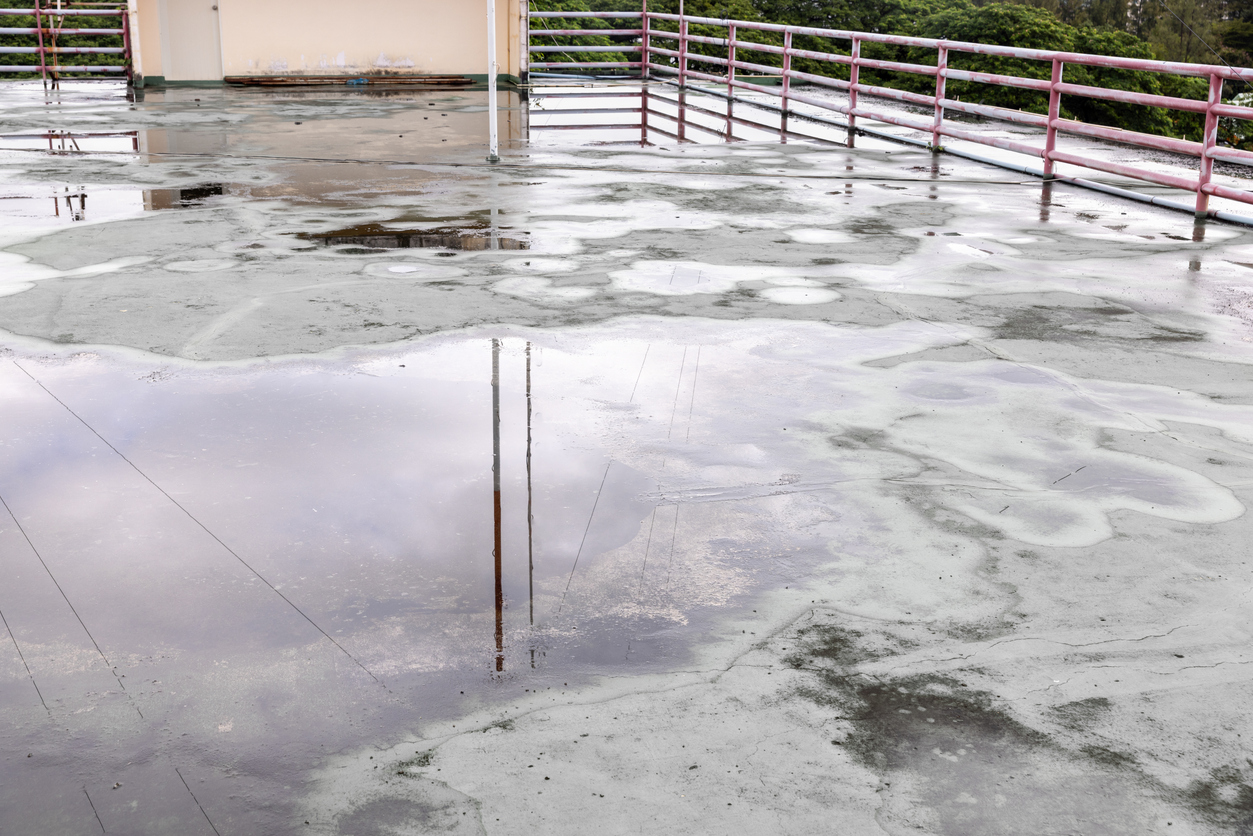
When primary drains become restricted by organic debris, water has nowhere to go. As water accumulates, several distinct mechanisms of damage occur:
- Ponding Water and Membrane Degradation: Standard low-slope roofing membranes are designed to shed water, not hold standing pools for extended periods. Ponding water accelerates the breakdown of roof seams, flashing, and seals, allowing water to find the path of least resistance into the building envelope.
- Dead Load Accumulation: Water is surprisingly heavy, weighing roughly 5.2 pounds per square foot for every inch of depth. A clogged drain system that allows just four inches of water to pool over a modest 5,000-square-foot section adds over 100,000 pounds of unexpected weight to the roof structure.
- Deflection Loops: As standing water adds weight, structural roof joists begin to deflect (sag) slightly. This deflection creates a low point that collects even more water, increasing the load further. In extreme cases, this self-reinforcing cycle leads to partial or total structural roof collapse.
Clogged Drains vs. Design Deficiencies: What Forensic Experts Look For
A forensic engineering investigation does not just look at the wet carpet inside; it evaluates the entire roof design, maintenance history, and local storm data to establish true causation.
During an inspection, forensic engineers evaluate several key factors:
- Primary vs. Secondary (Overflow) Drainage: Building codes require most commercial flat roofs to have a backup drainage system, such as secondary overflow scuppers elevated slightly above the main drain level. If the primary drains were clogged with leaves, did the secondary overflow drains function as designed, or were they also blocked, improperly installed, or omitted entirely during construction?
- Debris Characterization and Maintenance History: Was the blockage caused by a sudden, catastrophic storm that swept an extraordinary amount of fresh debris into the drains overnight? Or does the drain contain packed, decomposed organic matter indicative of months,or years of neglected maintenance?
- Flashing and Penetration Integrity: Water often enters building interiors through mechanical equipment curbs, wall flashings, or parapet seams long before the roof structure itself fails. Engineers examine whether the water level simply rose above the height of these protective flashings due to backed-up water.
- Historical Weather Data Comparison: By comparing local rainfall intensity (inches per hour) against regional historical averages, engineers determine whether the storm event exceeded local building design standards or if the drainage system simply failed under routine rainfall due to blockage.
The Importance of Prompt Forensic Evaluation
In water intrusion and roof load claims, physical evidence is highly perishable. Property owners naturally want to clear away clogged gutters, pump off standing water, and repair damaged membranes immediately to mitigate further loss.
However, clearing away the debris before a thorough inspection can erase vital clues regarding the cause of the backup. Retaining a forensic engineer early allows for:
- On-site documentation and photographic evidence of drain conditions before cleanup.
- Core sampling of roofing materials to distinguish between fresh water damage and long-term moisture entrapment.
- Precise elevation mapping to identify structural deflection and ponding low-points.
- Review of maintenance logs, architectural drawings, and local building code compliance.
By pairing clear physical findings with meteorological data and structural analysis, forensic engineers provide adjusters and legal teams with clear, objective answers, helping resolve coverage disputes and subrogation possibilities efficiently.