Shortcode Cleaner

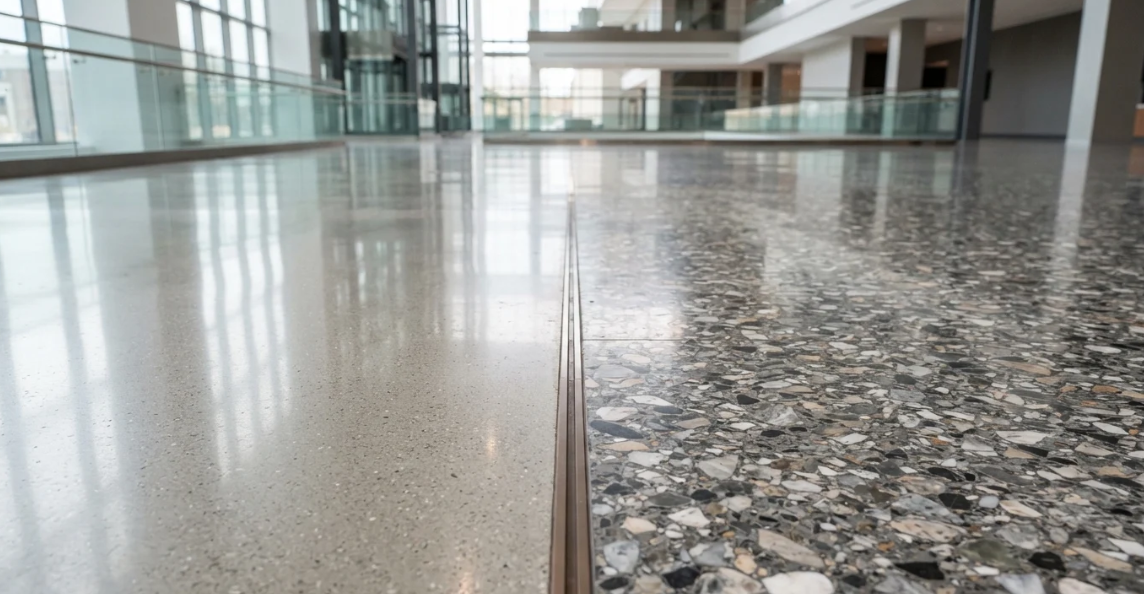
Modern commercial architecture increasingly favors open-concept floor plans with sleek, mixed-media surfaces. Polished concrete atrium floors merge seamlessly into luxury vinyl tile (LVT), transition into terrazzo near entryways, or decorative stone in high-traffic corridors. While visually striking, these modern design choices frequently create hidden, localized slip hazards.
Slip, trip, and fall claims remain among the most frequent and costly forms of premises liability litigation. However, evaluating a slip injury today extends far beyond asking whether a warning sign was present or if a spill was cleaned up. For property managers, insurance adjusters, and defense or plaintiff counsel, determining true liability requires a rigorous, scientific examination of surface slipperiness, material transitions, and human factors.
The Hidden Risk of Transitional Flooring
A primary driver of modern premises slip incidents is the sudden change in slip resistance as a pedestrian transitions from one flooring material to another. Human gait naturally adapts to the surface beneath it; when a walking surface abruptly shifts from a high-traction material to a low-traction material, or vice versa, the pedestrian’s body cannot instantly adjust its friction demand.
In high-traffic areas, several factors contribute to unexpected transitional failures:
- Differential Dynamic Friction Coefficients (DCOF): Two adjoining flooring materials may meet building code specs dry, but display vastly different frictional resistance when exposed to track-in moisture, cleaning chemical residue, or ambient humidity.
- Maintenance Incompatibilities: Modern surface materials require distinct cleaning protocols. Applying a wax or polish suited for terrazzo onto adjoining polished concrete or LVT can leave behind a slick, invisible film, dangerously lowering the friction coefficient across the threshold.
- Recessed Matting and Threshold Wear: Transition strips and recessed matting at building entryways can degrade unequally, creating both a subtle elevation differential (a trip hazard) and a localized drop in surface traction (a slip hazard).
The Science of Investigation: Tribometry and Motion Analysis
Determining whether a specific floor surface presented a dangerous condition at the time of an incident requires objective measurement, not subjective observation. Our engineers utilize specialized field instruments and biomechanical principles to quantify friction and evaluate human movement:
- Tribometer: To measure dynamic coefficient of friction accurately in the field, forensic engineers utilize automated digital tribometers. This specialized equipment measures friction force, wear rate, and lubrication behaviour between two contacting surfaces under controlled conditions
- Microscopic Surface Analysis: When chemical residues or wear patterns are suspected, optical profiling and microscopy allow engineers to evaluate surface micro-roughness to determine if wear, polishing, or improper sealant degraded the material’s slip resistance over time.
- Biomechanical Gait and High-Speed Motion Analysis: By analyzing surveillance footage alongside human gait biomechanics, engineers can evaluate the pedestrian’s stride length, heel-strike angle, and slip distance. This objective analysis helps separate a genuine slip hazard caused by low surface friction from an intentional trip, a balance loss due to medical factors, or a misstep.
Evaluating Liability and Building the Case
Premises liability claims surrounding modern flooring designs are rarely black and white. Establishing whether a surface met acceptable traction thresholds, or whether an architectural transition posed an unreasonable danger, requires isolating the precise physical interaction between footwear, contaminants, and floor substrate.
At CED Technologies, our multidisciplinary team of engineers provide clear, data-driven analysis for both defense and plaintiff counsel. By combining field tribometry with rigorous engineering methodologies, we cut through assumptions to uncover the scientific facts behind the fall.