Shortcode Cleaner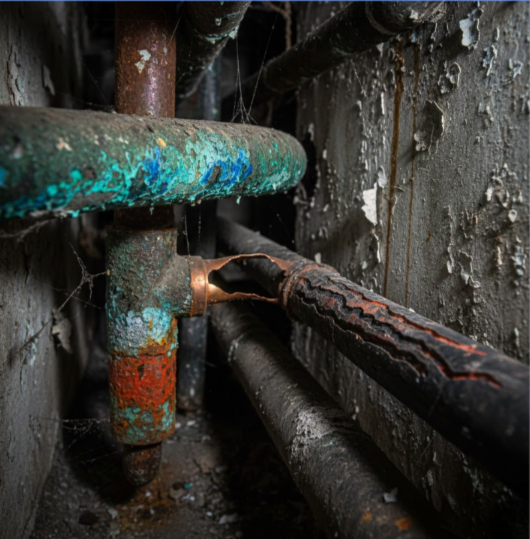
While a deep freeze often appears to be the primary cause of burst pipes, forensic analysis frequently reveals that the cold merely triggers a “ticking time bomb” of pre-existing corrosion, metallurgical fatigue, or manufacturing defects. Distinguishing between a sudden environmental event and long-term mechanical failure is essential for determining whether a rupture is a routine insurance claim or a complex liability dispute.
The Anatomy of a Freeze
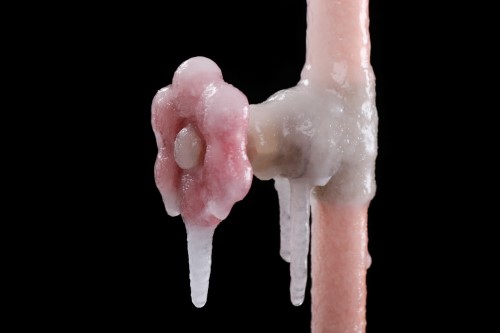
When water freezes, it expands by approximately 9%. In a standard plumbing system, this expansion creates localized pressure spikes that can reach over 25,000 psi, far exceeding the burst rating of any residential pipe.
In copper, a freeze burst typically manifests as a “tulip” or “longitudinal tear”. The copper distends outward before the wall thins and eventually zips open. Conversely if a pipe fails without significant thinning of the walls or “ballooning” around the break, the culprit is likely brittle failure. This points toward manufacturing defects, such as improper annealing in copper or “oxidative induction” issues in PEX. where the material becomes brittle over time and snaps under even moderate pressure.
Copper Piping: Pitting and Erosion-Corrosion
Copper has been long gold standing but it is not invincible. Forensic investigators often find that a “freeze burst” occurred at a spot already weakened by internal degradation.
Pitting Corrosion: Small, localized holes caused by water chemistry imbalances. If an engineer finds malachite or deep pits near the burst site, the pipe was already compromised by age or poor water quality.
Erosion-Corrosion: Common in hot water return lines, high velocity water can literally “scrub” the protective lining off the inside of a copper bend. If the pipe wall is paper thin at the point of failure, the installer or the system design is to blame, not the weather.
The PEX Evolution: Chlorine and UV Degradation
Cross-linked polyethylene is flexible and resistant to freeze expansion, which makes it popular in modern builds. However, it has unique failure modes that require a molecular level investigation.
Oxidative Reductive Failure: If polyethylene is exposed to high levels of chlorine or kept at high temperatures for too long the antioxidants within the plastic dissipate. The pipe becomes brittle from the inside out. In a forensic lab this is identified by a “micro-cracked” appearance on the inner wall.
UV Exposure: Polyethylene left on a job site for weeks before installation can be damaged by sunlight. This weakens the polymer chains, leading to a “brittle snap” failure month or years later during a standard pressure surge.
The Role Of CED Technologies
When a massive water loss occurs, whether in a high rise luxury condo or a sprawling industrial warehouse, the “why” is rarely found on the surface. CED Technologies bridges the gap between the initial mop-up and the final legal resolution.
On-Site Evidence Preservation: Our engineers don’t just look at the break; they examine the support hangers, insulation thickness, and proximity to external vents to rule out environmental negligence.
Metallurgical and Materials Lab Analysis: Using Scanning Electron Microscopy (SEM), CED can look at the “fracture face” of the pipe. A clean, granular break tells a very different story than a jagged, stretched tear. We can identify whether a PEX pipe failed due to chemical degradation or a manufacturing knit-line defect.
Root Cause Determination: We provide the data backed answer: Was this a failure of the building's HVAC system to maintain heat, a plumber's failure to debur the pipe, or a manufacturer’s failure to produce a sound product?
By pinpointing the exact mechanism of failure, CED Technologies empowers our clients to pursue subrogation with confidence or defend claims based on hard science rather than seasonal assumptions.